Greetings from the high stakes steak craft world! A truly great meal, in our opinion, begins long before the heat is applied. It begins with the animal’s heritage, the butcher’s skillful cut, and above all the chemistry that takes place on the meat’s surface in your own kitchen.
You are asking the most crucial question in home butchery if you have ever gazed at a quality ribeye and wondered when to reach for the saltshaker. Is adding salt a pre-grilling or post-searing step? The distinction between a good steak and a sublime steak is the answer.
The real function of salt
We must examine the effects of salt on proteins to comprehend the timing. Salt is a useful tool that alters the meat’s physical structure in addition to adding flavour.
A remarkable three-step process starts when you salt a raw steak:
- The draw: Through osmosis, the salt extracts moisture from the meat in a matter of minutes. On the surface, little brine beads will start to develop. That moisture will turn to steam if you cook the steak right now, which will keep a nice crust from developing.
- The dissolve: A highly concentrated brine is produced when the salt dissolves in that moisture.
- The reabsorption: The concentrated brine is drawn back deeply into the centre of the wound as the salt starts to dissolve the resistant muscle fibres.
The golden window
There are only two appropriate times to salt a steak. In the culinary world, everything in between is a “no man’s land.”
Option A: The instant sear
If you are pressed for time, salt the meat and add it to the pan in less than 90 seconds. This guarantees that the moisture hasn’t had a chance to escape and that the salt remains on the surface. Although the inside of the meat will not be seasoned, you will get a good crust.
Option B: The 45-minute rule (expert choice)
You must wait at least 45 minutes after salting if you want the Berliner standard. Even better, salt the steak the night before and store it in the refrigerator, uncovered. This enables the meat’s surface to become bone dry and the brine to completely reabsorb.
The Maillard process, which produces the rich, mahogany crust that every cook aspires to, requires a dry surface. Your pan’s energy will be used to boil away water instead of scorching the meat if the surface is moist.
Different salts have different properties
Fine table salt should not be used as your primary spice, any more than you would use a cheap bottle sauce on a dry aged sirloin.
- Our favourite at the butchery is coarse sea salt. A controlled release of taste and a tactile crunch are provided by the bigger grains.
- Kosher salt is very simple to pinch and uniformly apply across a broad cut because of its flat, flaky nature.
- Save the delicate, pyramid-shaped Maldon or finishing salt flakes for the very end. Just prior to the initial bite, they provide a crisp, vivid burst of salinity.
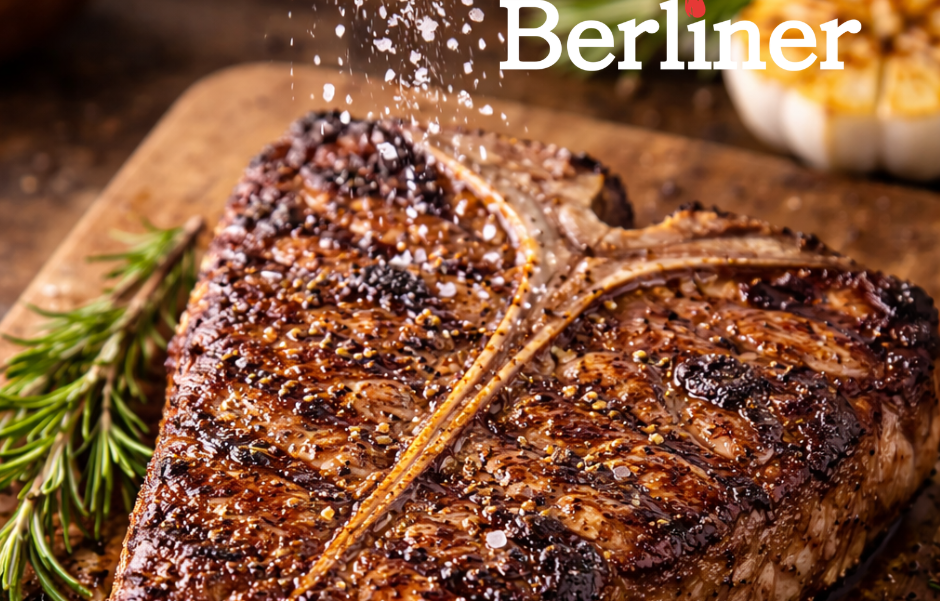
The perfectly seasoned T-Bone (recipe)
It’s time to apply the theory. The “Dry Brine” method, which is the main focus of this recipe and is the best approach to honour a premium cut of beef.
What you’ll need:
Cut: 2x Berliner T-bone steaks (500g each)
Salt: Coarse sea salt
Fat: High smoke point oil or beef tallow.
Veg & herbs: 3x cloves of mashed garlic, a knob of chilled butter, and a sprig of thyme.
Recipe
Step 1: Preparation
The night before cooking, arrange the steaks on a wire rack over a baking sheet. To guarantee uniform coating, liberally season them with the coarse salt while standing at a height of around 30cm. Remember the fat cap around the edges! Keep them uncovered in the refrigerator for a minimum of 12 hours.
Step 2: The temperature
An hour before cooking, remove the steaks from the refrigerator. The meat will have a richer, darker crimson colour and feel sticky and dry to the touch. This is precisely what you need.
Step 3: Sear at high heat
Heat your heaviest skillet until smoke is beginning to whisper. Put in your fat. The steak will almost immediately start to form a crust because it is already dry from the salt treatment. For a medium-rare finish, sear for 3 minutes on each side.
Step 4: The butter baste
Reduce the heat a little and add the thyme, garlic, and butter. Spoon the butter over the steaks several times until it foams and becomes nut brown. Now the rich, fragrant fats will start to balance the salt already present in the meat.
Step 5: Rest
Transfer the steaks to a platter that is heated. Over them, pour the leftover pan juices, and then wait. You must rest for 8 minutes for a cut this size. When you slice the meat, the seasoned fluids will remain within because the internal pressure will have stabilised.
Some easy weekend grilling tips
- Don’t be salt stingy: A thick steak requires more seasoning than you may realise, so don’t be afraid of the salt. A large portion will remain on the grill grates or in the pan.
- Avoid the pepper: At extremely hot temperatures, pepper can burn and turn bitter. Instead, add your cracked black pepper while it’s resting.
- Keep an eye on the moisture: Before salting, blot dry the steak with a paper towel if it is perspiring when it comes out of the package. The sear’s adversary is moisture.
The Berliner difference
Why is the timing of a few grains of salt so important to us? Because we at Berliner consider ourselves to be the link between your family table and the farm.
Our goal has been to preserve the strict customs of European butchery since 1949. You are interacting with a tradition of craftsmanship whether you are visiting us in store or online. When you follow these instructions, the outcome will be nothing short of stunning because we choose our proteins with an eye for maturity and marbling.
A complex recipe is not necessary to make a superb steak. It requires an awareness of the basic, scientific concepts that give such flavours life as well as respect for the unprocessed substances.